EquipmentChapter the Sixth
Equipment
How much a character can carry, and what a pack animal or a canoe can hold, is covered in Carrying, in chapter 13.
Money
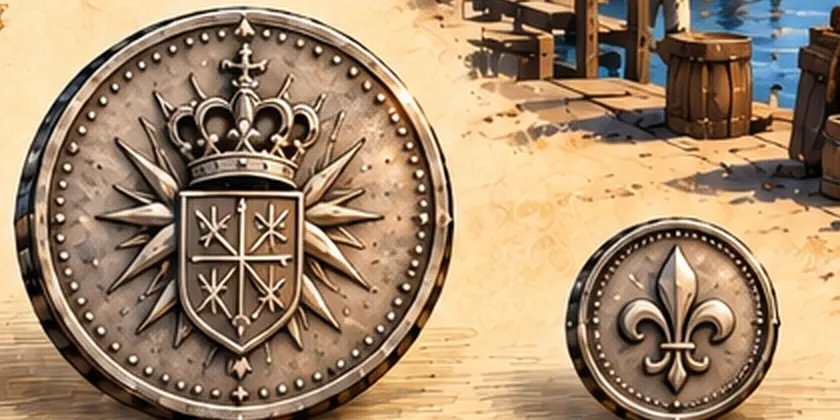
One silver coin is accepted everywhere: the piece, minted by the southern crown. It divides into 10 bits. A price in bits is written with a b, so 4b is four bits; a bare number is pieces. A labourer earns about 4 bits a day.
1 piece (10 bits) — 1 bit (1/10 of a piece)
Where the coin comes from
The piece is struck from the silver of the kingdoms the southern crown toppled in the far south, and no one else on the continent mints coin. The crown ships most of its silver home, so the coin that stays passes from hand to hand for years, and there is never enough of it.
| Who | How they use coin |
|---|---|
| The southern crown | Pays its soldiers, priests and officials in its own pieces, and collects them back in taxes and tithes. |
| The charter colonies | Mint nothing. They pay taxes and wages in crown pieces they cannot make more of, and much of their trade runs on credit and promises to pay at harvest. |
| The river traders | Take their wealth in furs and pay for them in goods. Coin matters most to them at the forts. |
| The merchant company | Keeps accounts and writes bills of credit that its own factors will honour and almost no one else will. |


How money is used
The Crown's silver piece is accepted everywhere, but among the elves, dwarves and halflings it is not equally important. The table describes common practices rather than rules every individual must follow.
| New World people | How money is used | Trade and payment |
|---|---|---|
| Forest elves | Pieces are accepted in dealings with outsiders but do not govern every exchange within the League. | Goods, obligations and negotiated exchanges matter alongside coin; formal agreements carry weight. |
| River elves | Coin is useful when trading with settled peoples, but the boat-clans are not dependent on it. | Boat transport, cargo and exchanged goods sustain their travelling trade. |
| Plains elves | Silver is an important and visible sign of wealth, especially among those trading with newcomers. | Horses and hides go out; silver, cloth and steel come back. |
| Canyon dwarves | Pieces are useful for dealings with the Crown and outsiders; local exchange need not depend on coin. | Stonework, metalwork and rune-forged goods may be exchanged for scarce supplies. |
| Shore dwarves | Coin is accepted in outside trade, but copper and skilled workmanship are wealth in their own right. | Copper, tools and finished metalwork are important trade goods. |
| Halfling homesteads | Pieces pay for purchases beyond the homesteads, including land and outside supplies. | Farm produce, neighbourly credit and direct exchange also sustain local trade. |


Armour
Armour is bought and worn per location, and each location matches a result on the hit location die: head, body, arms and legs. A character can mix pieces, such as a steel helmet over a buckskin coat. Creatures have natural armour on the same scale.
- Value is the armour value for that location only. A location with nothing on it has a value of 0.
- Drawbacks add together across the pieces worn. The Sturdy talent reduces the total.
- A coat in a career's trappings, such as a buckskin, heavy or wolf coat, covers the body and arms.
- A full set is one piece for each location, and costs the total of the four. Wooden slat armour is native-made. Full plate is an heirloom or dwarven work, and is not for sale.
Head armour
Protects the head and face.
| Armour | Value | Price | Drawback |
|---|---|---|---|
| Padded cap or fur hood | 1 | 2b | None |
| Hardened leather cap | 2 | 1 | None |
| Wooden helmet | 3 | 1 | None |
| Mail coif | 3 | 3 | None |
| Steel helmet | 4 | 3 | None |
| Plate helm | 5 | Not for sale | None |
Body armour
Protects the chest, back and abdomen.
| Armour | Value | Price | Drawback |
|---|---|---|---|
| Padded jack or buckskin shirt | 1 | 1 | None |
| Hardened leather or hide jerkin | 2 | 4 | None |
| Wooden slat or rod cuirass | 3 | 3 | -1 Stealth |
| Mail shirt | 3 | 12 | -1 Stealth |
| Brigandine, half plate or breastplate | 4 | 12 | -1 Stealth and Acrobatics |
| Plate cuirass | 5 | Not for sale | -1 Stealth and Acrobatics |
Arm armour
Protects the upper and lower arms.
| Armour | Value | Price | Drawback |
|---|---|---|---|
| Padded or buckskin sleeves | 1 | 4b | None |
| Hardened leather bracers | 2 | 1 | None |
| Wooden slat bracers | 3 | 1 | None |
| Mail sleeves | 3 | 4 | None |
| Steel vambraces | 4 | 4 | None |
| Plate arms | 5 | Not for sale | None |
Leg armour
Protects the thighs, legs and feet.
| Armour | Value | Price | Drawback |
|---|---|---|---|
| Padded or buckskin leggings | 1 | 4b | None |
| Hardened leather greaves | 2 | 2 | None |
| Wooden slat greaves | 3 | 1 | None |
| Mail leggings | 3 | 6 | None |
| Steel tassets and greaves | 4 | 6 | -1 Movement |
| Plate legs | 5 | Not for sale | -1 Stealth and Acrobatics, -1 Movement |

Weapons
Older weapons and gunpowder weapons are both in use. Gunpowder is new, elves and dwarves never adopted it, and armour still matters.
Damage is the weapon's base damage, before Might or Agility and the margin are added. P marks Piercing. Range is the band a ranged weapon reaches without penalty; see Range and distance in Combat. A knife or a hatchet appears in both tables, since it can be used in the hand or thrown. Might marks a ranged weapon that adds Might to damage instead of Agility. Agility marks a light melee weapon that can add Agility to damage instead of Might; see chapter 8, Combat.
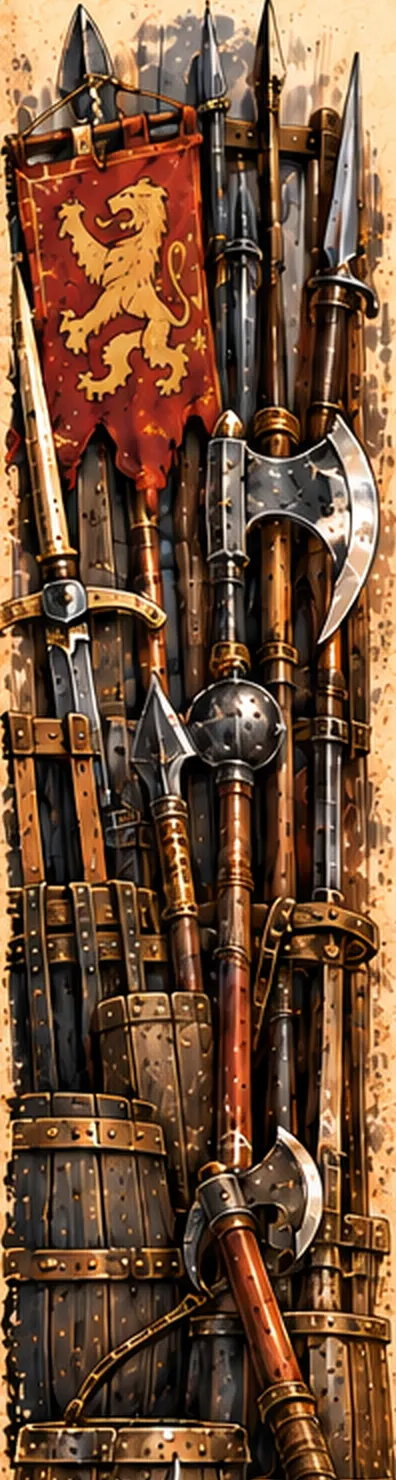
Melee weapons
| Weapon | Group | Damage | Price | Notes |
|---|---|---|---|---|
| Unarmed | Brawling | 1 | None | |
| Improvised | Brawling | 2 | None | |
| Dagger or knife | Basic | 2 | 5b | Agility. Can be thrown |
| Club | Basic | 3 | Free | |
| Hatchet or tomahawk | Basic | 3 | 1 | Can be thrown |
| Smallsword | Basic | 3 (P) | 8 | Agility |
| Axe | Basic | 4 | 2 | |
| Hanger or cutlass | Basic | 4 | 4 | |
| Mace | Basic | 4 (P) | 3 | |
| Sabre | Basic | 4 | 6 | |
| Sword | Basic | 4 | 5 | |
| War club | Basic | 4 (P) | 1 | |
| Warhammer | Basic | 4 (P) | 4 | |
| Whip | Flexible* | 2 | 1 | Agility |
| Flail | Flexible* | 5 | 4 | |
| Spear or fixed bayonet | Polearms* | 4 | 1 | |
| Halberd | Polearms* | 5 | 4 | |
| Lance | Polearms* | 6 | 3 | Usable only when mounted. A mounted charge is a critical hit. |
| Staff | Staves | 3 | Free | |
| Great axe | Two-Handed* | 6 | 3 | |
| Greatsword | Two-Handed* | 6 | 12 | |
| Maul | Two-Handed* | 6 (P) | 3 |


Ranged weapons
Older weapons and gunpowder weapons are both in use. Gunpowder is new, elves and dwarves never adopted it, and armour still matters.
Damage is the weapon's base damage, before Might or Agility and the margin are added. P marks Piercing. Range is the band a ranged weapon reaches without penalty; see Range and distance in Combat. A knife or a hatchet appears in both tables, since it can be used in the hand or thrown. Might marks a ranged weapon that adds Might to damage instead of Agility.
| Weapon | Group | Damage | Range | Price | Notes |
|---|---|---|---|---|---|
| Thrown knife | Basic | 2 | Near | 5b | Also a melee weapon, as a dagger or knife. |
| Javelin | Basic | 3 | Near | 5b | Might. |
| Sling | Basic | 3 | Far | Free | |
| Thrown axe | Basic | 3 | Near | 1 | Might. Also a melee weapon, as a hatchet or tomahawk. |
| Shortbow | Bows* | 3 | Far | 2 | |
| Longbow | Bows* | 4 | Long | 4 | |
| Composite bow | Bows* | 4 | Far | 6 | Might. |
| Light crossbow | Crossbows | 5 (P) | Far | 8 | Reload 1 round. |
| Heavy crossbow | Crossbows | 7 (P) | Far | 12 | Reload 2 rounds. |
| Pistol | Firearms* | 6 (P) | Near | 6 | Reload 2 rounds. |
| Blunderbuss | Firearms* | 7 | Near | 8 | Cannot shoot beyond Near. Reload 2 rounds. |
| Trade musket | Firearms* | 8 (P) | Far | 6 | Light and cheap. Reload 2 rounds. |
| Military musket | Firearms* | 8 (P) | Far | 10 | Takes a bayonet. Reload 2 rounds. |
| Long rifle | Firearms* | 8 (P) | Long | 20 | Reload 3 rounds. |
| Ballista | Artillery* | 12 (P) | Long | 40 | Needs a crew. |
| Swivel gun | Artillery* | 12 (P) | Long | 60 | Boat or wall mounted. |
| Field cannon | Artillery* | 16 (P) | Long | 400 | Needs a crew. |
Twenty arrows or bolts cost 1. Powder and shot for 5 rounds cost 1, four times the price per shot.


Who carries what
Each people fights in its own way, shaped by its land, its history and what it can make or buy. The table shows the weapons and armour each is known for. It is a guide to what a character is likely to carry, not a rule: anyone can use any weapon they have the skill for.
| Weapons and armour | Typical users |
|---|---|
| Longbow, spear, war club, slat armour | Forest elves |
| Lance, shortbow, sabre | Plains elves |
| Knives, light crossbows, hidden blades | River elves |
| Maul, warhammer, great axe, mail and plate | Canyon dwarves and shore dwarves |
| Greatsword, halberd, mace, breastplate | Southern crown |
| Sling, staff, hatchet | Halfling homesteads |
| Musket, pistol, bayonet, hanger | Charter colonies, river traders and merchant company. |
Trade goods
Away from the coast and the river towns, most trade is done in goods, not coin. The fur trade runs on the pelt: a prime pelt trades as 1 piece. The goods that pass for money on the frontier are the ones in the price lists below: powder and shot, knives and hatchets, copper kettles, wool blankets, glass and shell beads, tobacco and rum.
- Listed prices are coast prices. In the back country, goods from the coast are worth more and coin buys less. A trading post far upriver may ask up to double, or refuse coin and ask for pelts.
- Goods for goods are reckoned at their listed prices, and a good bargainer can shift the balance a bit or two either way.
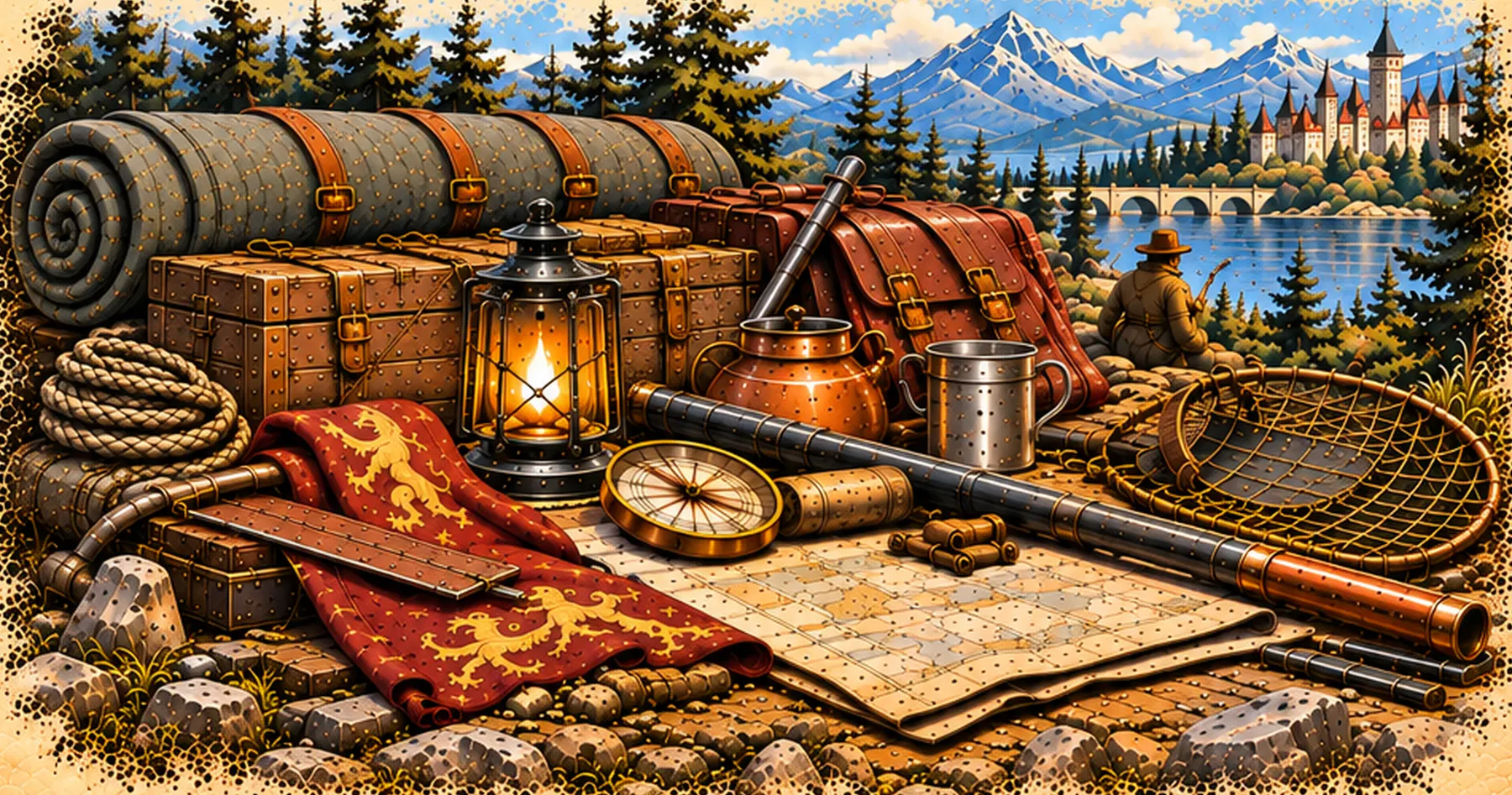

Goods
Everything in a career's trappings can be bought here, along with what most travellers need. A holy book is priced as a book and a keg of powder as powder and shot.
Powder and shot, knives and hatchets are in Weapons, and pass as trade goods too.
Trade, travel and camp
| Item | Price |
|---|---|
| Birchbark canoe | 8 |
| Canvas tent | 4 |
| Compass | 4 |
| Copper kettle | 2 |
| Cord, one length | 1b |
| Fish hooks and line | 2b |
| Flint and steel | 2b |
| Glass beads, one string | 2b |
| Hooded cloak | 1 |
| Lantern and oil | 1 |
| Marker stakes, one bundle | 1b |
| Pack mule | 20 |
| Regional map | 5 |
| Riding horse | 30 |
| Rope, 50 feet | 5b |
| Item | Price |
|---|---|
| Rum, one flask | 2b |
| Rum, one gallon | 1 |
| Saddle and tack | 8 |
| Salt, one jar | 2b |
| Shell beads, one string | 5b |
| Snowshoes | 2 |
| Spyglass | 15 |
| Steel trap | 2 |
| Tin cup | 1b |
| Tobacco, one twist | 5b |
| Travelling clothes | 2 |
| Twine, one ball | 1b |
| Week's rations | 1 |
| Wool blanket | 3 |
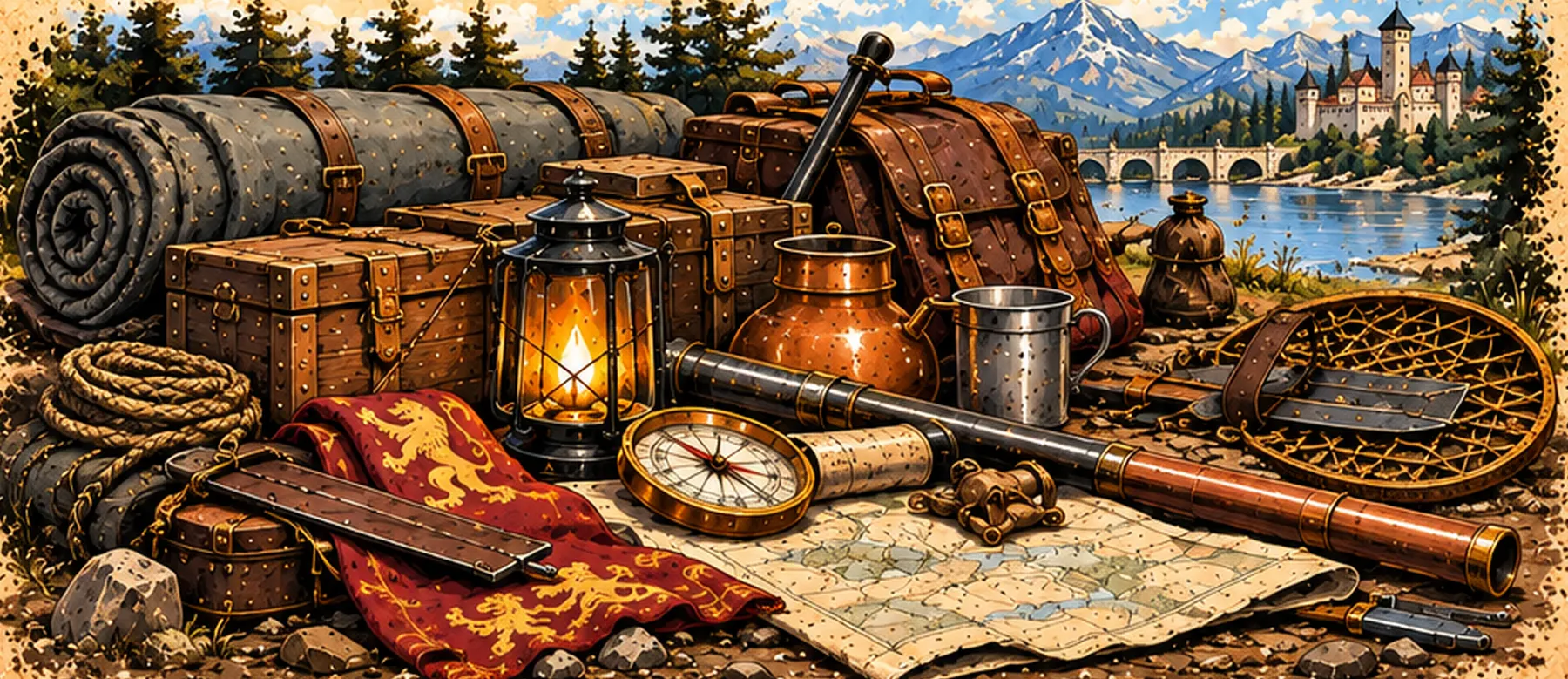
Tools and other gear
The people of the New World need many tools and useful items for travel, trade and daily life. This table shows common gear and supplies, with typical prices.
| Item | Price |
|---|---|
| Bayonet | 1 |
| Begging bowl | 1b |
| Book | 3 |
| Bottled remedies, one case | 1 |
| Engraving tools | 5 |
| Face paint, one pot | 2b |
| Fiddle or flute | 5 |
| Fine clothes | 6 |
| Gloves | 5b |
| Gun-cleaning kit | 5b |
| Hammer | 5b |
| Hand wraps | 1b |
| Herbs, one pouch | 2b |
| Holy symbol | 5b |
| Leeches, one jar | 5b |
| Liniment, one jar | 2b |
| Loaded dice | 1 |
| Lockpicks | 5 |
| Magnifying lens | 3 |
| Manacles | 2 |
| Item | Price |
|---|---|
| Mask | 1b |
| Pack of cards | 2b |
| Pennant | 5b |
| Performer's costume | 2 |
| Powder horn | 5b |
| Pry bar | 5b |
| Sealing wax and seal | 1 |
| Slow match and fuse | 5b |
| Songbook | 1 |
| Spare bowstring | 1b |
| Surgeon's kit | 10 |
| Surveyor's instruments | 20 |
| Whetstone | 1b |
| Whistle | 2b |
| Writing kit | 1 |
Not for sale: runic artefacts, and papers such as a letter of introduction, letter of marque, warrant, writ of authority or employer's badge. These are granted, earned or otherwise acquired.
