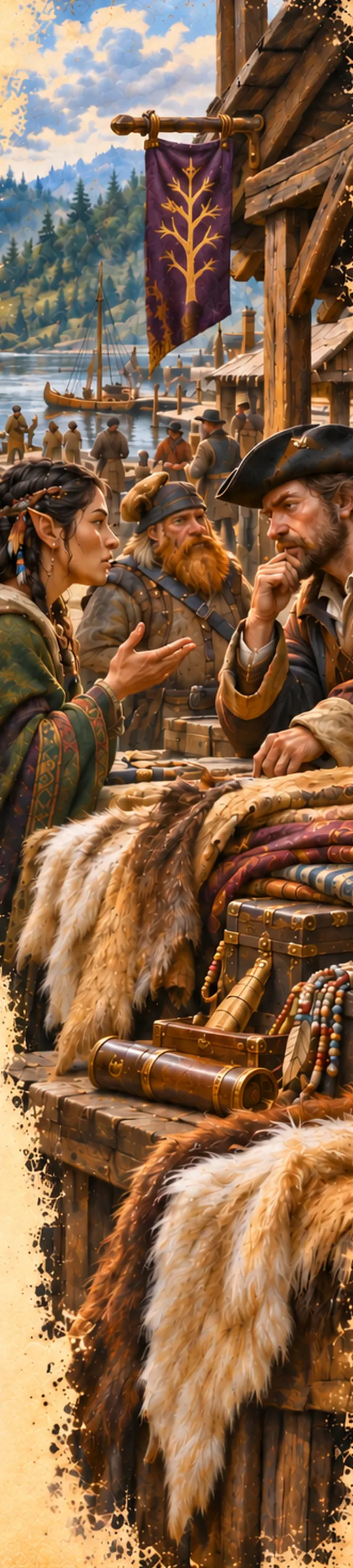
A halfling, an elf, a dwarf holding a copper jug and a gentleman in a tricorn hat confer on a lakeside dock.

Species and peoples

Every character belongs to one people of their species, chosen when the character is made. A new character gets two species talents free: the one shared by their whole species, and one of the two listed on the particular Species page.

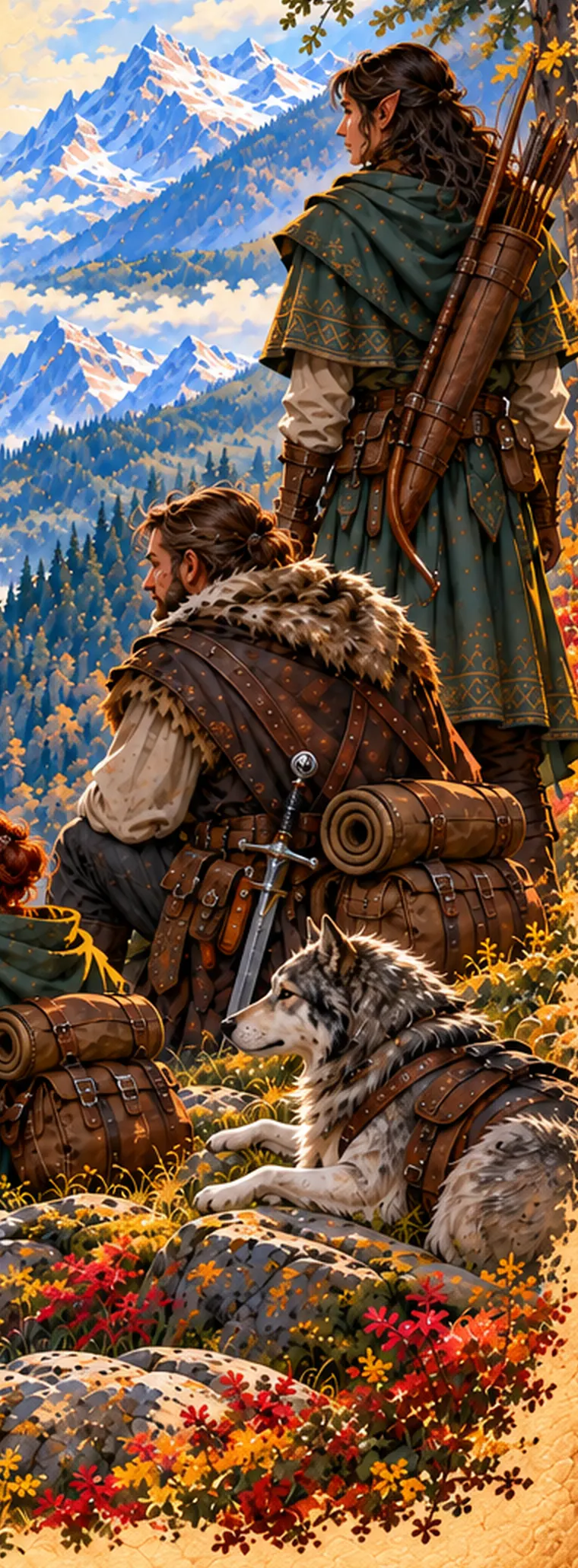
An elf archer, a seated traveller and a wolf look out over mountains.

Species talents are ordinary talents. They are detailed in chapter 5, Talents, and follow every talent rule, including one talent per roll. Note your two free talents on your character sheet.

The species talent of the pair that was not taken can still be bought later with experience, at any time, for 1 experience.

A talent with a species or a people as its prerequisite can be taken only by that species or people.

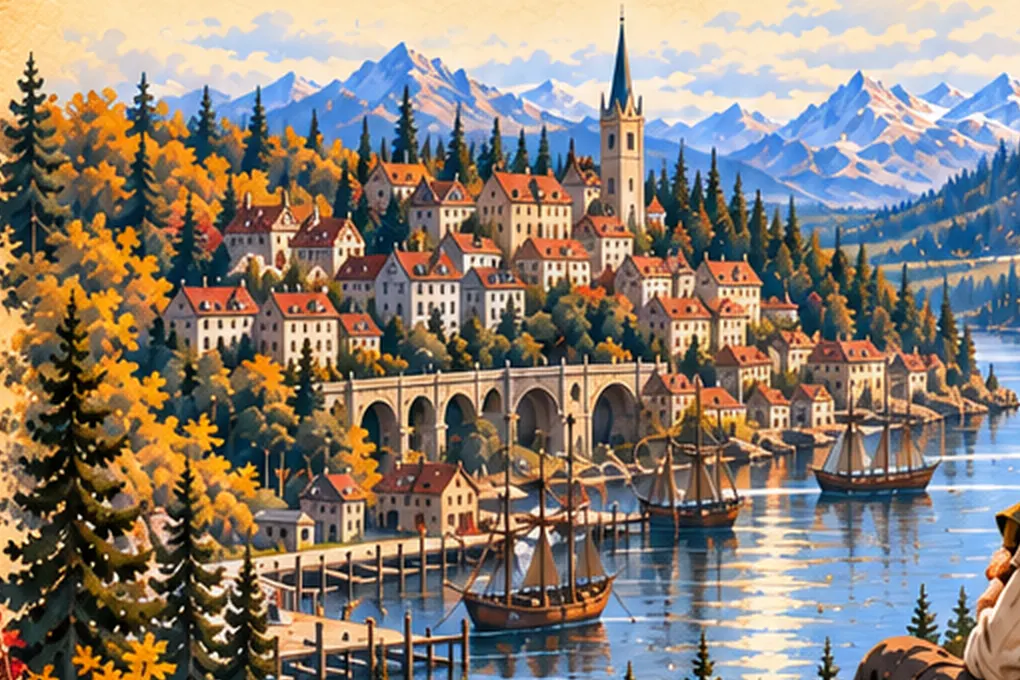
A harbour town with tall ships among autumn forest and mountains.

Canyon Dwarves

Stone runs deep. Water remembers.

Free talentChoose one
Night VisionScale Sheer Surface or Dry-Country
Armoured canyon dwarves with warhammers overlook a red-rock cliff city.

The canyon dwarves built their towns into the cliffs and mesas of the red canyon country eight hundred years ago, and tied their rune-craft to water and stone.

Like all dwarves they see well in poor light, in a windowless cliff room as easily as under the sun (Night Vision).

Their streets are ladders and hand-holds, and they climb before they can read (Scale Sheer Surface).

Their country gives little water and less shade, and they bear heat and thirst that would put a newcomer on the ground (Dry-Country).

A hundred and twenty years ago the southern crown planted missions and garrisons among them and forbade the cutting of runes.

Forty-five years ago they rose as one, drove the crown out for twelve years and relit the rune-forges. The crown came back, but on terms, and the forges stay lit behind closed doors.

They call the Worldsoul the Deep, and go to war with maul, warhammer and great axe.

Scale Sheer Surface

Their streets are ladders and hand-holds, and they climb before they can read.

Dry-Country

Their country gives little water and less shade, and they bear heat and thirst that would put a newcomer on the ground.

Tools and wargear

  • Maul, warhammer and great axe.
  • Rune tools for stone and water.
  • Water is life.
  • Runes bind stone, water and memory.
A cliff city of stone bridges and waterfalls.
Canyon dwarf towns cling to the cliffs and mesas, built with stone, water and time.
A dwarf smith hammers glowing metal at a forge.
The forges stay lit behind closed doors.
A dwarf pack train with laden mules crosses red canyon country.
Canyon dwarves travel hard country with little water and fewer complaints.

Shore Dwarves

Deep waters. Strong works. Lasting craft.

Free talentChoose one
Night VisionCopper-Wise or Lake-Hardened
Shore dwarves stand among copper ingots above a busy lakeside harbour.

The shore dwarves live beside the inland seas, waters so wide that the far shore cannot be seen. They have worked the lake copper since before the elves kept count, and they were the first to cut a rune into metal. Every runewright on the continent works in a craft that began with them.

Like all dwarves they see well in poor light, in a mine gallery or under a winter sky (Night Vision).

They grow up around the copper, and can judge a piece of metal by its colour, its weight and its ring (Copper-Wise).

The great waters are cold in every season and the weather comes off them without warning, and the shore dwarves work through wet and cold that would send others indoors (Lake-Hardened).

They call the Worldsoul the Deep. In war they carry the maul, the warhammer and the great axe, and wear mail and plate of their own making.

Copper-Wise

Can judge a piece of metal by its colour, its weight and its ring.

Lake-Hardened

Work through wet and cold that would send others indoors.

Tools and craft

  • Maul, warhammer and great axe.
  • Runes cut in metal, a craft that began with them.
  • Tools of the runewright and metalworker.
  • Lake copper shaped into works that last.
Dwarf workers handle cargo beneath a blue banner on a ship.
Ships, trade and strong works bind the dwarf towns to every shore.
A dwarf smith strikes red-hot metal at a forge.
The first to cut a rune into metal.
  • Dwarf towns line the shores of the great waters.

Forest Elves

Free talentChoose one
Night VisionRover or Etiquette
Forest elves in leaf-scale armour draw a longbow above a river valley.

The deep forest that covers the eastern third of the continent belongs to the forest elves.

Three hundred and fifty years ago five of their nations ended their wars with one another and founded the League under a single law.

Like all elves they see well in poor light, and the forest floor at dusk is no hindrance to them (Night Vision).

They are raised in the woods and move through them without leaving much sign (Rover).

They are also raised in the League, where a matter is settled by speaking in the proper order and the proper form, and where a careless word can cost a nation its hearing (Etiquette).

The League fought the long Pelt Wars for the fur country, then made the Great Peace with thirty other nations and declared itself neutral between the crowns. It is now being pressed to choose a side.

Its warriors carry the longbow, the spear and the war club, and wear armour of wooden slats.

Rover

Raised in the woods and move through them without leaving much sign.

Etiquette

A matter is settled by speaking in the proper order and form, and a careless word can cost a nation its hearing.

Tools of the trade

  • Longbow for hunting and war.
  • Spear for war and the hunt.
  • Arrows with natural feather fletthing.
  • Armour of wooden slats, light and quiet in the forest.
  • War club for close combat.
Two forest elves with a spear and a knife on a mossy slope.
Forest elves in a canoe on a lake before a waterfall and a distant city.

Plains Elves

Free talentChoose one
Night VisionSaddle-Born or Open-Sky Eyes
Plains elves on horseback ride across the grassland above a river.

West of the great river the grass goes on for weeks, and it belongs to the plains elves.

They are the wealthiest people on the continent, and no one has done better out of trade with the newcomers. Forty-five years ago the loosed herds of the southern ranches spread north, and the plains elves became the finest riders anywhere; a child there is put on a horse almost as soon as it can sit (Saddle-Born).

Horses and hides go out, and silver, cloth and steel come back. A plains elf of any standing wears a tailored coat, drinks from glass, and has taken up the newcomers' manners along with their goods: the bow, the toast, the calling card, and the habit of settling honour with steel.

Like all elves they see well in poor light, and a night ride under the stars is nothing to them (Night Vision). The open country teaches its own skill, and they can pick out a rider, a herd or a thread of smoke at distances others would call empty sky (Open-Sky Eyes).

They fight from the saddle with lance, shortbow and sabre. They call the old tuskers elders and will not hunt them, and their Keepers still have an older word of their own for working the Worldsoul, the Under-Song.

Saddle-Born

A child of the plains is put on a horse almost as soon as it can sit.

Open-Sky Eyes

Can pick out a rider, a herd or a thread of smoke at distances others would call empty sky.

Tools of the trade

  • Lance for mounted combat.
  • Sabre for close work and honour.
  • Shortbow for hunting and the trail.
  • Saddle, travel gear and trade goods.
  • Glass and newcomer goods.
  • Calling card.
Elves and traders in tricorn hats toast with glasses over trade chests.
The old tuskers are called elders, and will not be hunted.
Riders approach a grazing herd on the open plains.

River Elves

Free talentChoose one
Night VisionRiver-Born or Clan Silence
River elves in feathered dress paddle a decorated canoe at sunset.

The river elves are the twilight elves, and they call themselves river people.

They were once the greatest people on the continent, with cities of raised earth joined by water along the great river and its tributaries. Five hundred and fifty years ago the cities emptied within a single lifetime, and nobody outside the clans knows why. The mounds still stand, and the river people will not live near them, land at them or say what happened there.

Their descendants are the boat-clans, who trade, carry, smuggle and move on, and who never settle.

Like all elves they see well by starlight and lantern-glow, which suits a people who do much of their travelling and most of their business after dark (Night Vision).

A child of the clans can swim before walking and handle a boat before either is expected of them (River-Born). Every one of them also grows up knowing theng are things the clan does not say, and learns young how to turn a question aside or deny it flatly (Clan Silence). Ask about the old cities and the talk turns to something else; ask twice and the boat is gone by morning.

They keep knives, light crossbows and hidden blades close, and have no patience for the antiquarians who dig their mounds. Their Keepers have an older word of their own for working the Worldsoul, the Braiding, and they do not explain that either.

River-Born

A child of the clans can swim before walking and handle a boat before either is expected of them.

Clan Silence

Learn young how to turn a question aside or deny it flatly. Some things the clan does not say.

Two standing river elves in fringed dress, one holding a spear.
The old cities still stand, but the river people will not land at them, nor say what happened there.
River elves sit around a campfire in a boat under the moon.
Keep knives, light crossbows and hidden blades close.
  • Travel, trade, carry, smuggle and move on.

Halfling Homesteads

Good land. Quiet folk. Strong roots.

Free talentChoose one
OverlookedStubborn or Homestead-Raised
A halfling family with a dog and a basket of produce on a stone-walled homestead.

The halflings came across the ocean with the humans, and eighty-five years ago they founded their homesteads on a promise of fair dealing. They bought their land instead of taking it, and they mean to be left alone on it.

They are small, quiet and plainly dressed, and bigger folk have a habit of not noticing that one is in the room (Overlooked).

They do not bend easily: a halfling who has decided a thing is wrong will not be argued, bullied or ordered into it (Stubborn).

They are farmers first, raised to the field, the orchard and the byre, and can get a living out of ground that others would walk past (Homestead-Raised).

They keep a magic of their own, of bread, fire, threshold and field, which they call the Hearth. Those who hunger for the Worldsoul overlook it, and those who want the Worldsoul ended rarely think it worth burning.

They carry the sling, the staff and the hatchet.

Stubborn

A halfling who has decided a thing is wrong will not be argued, bullied or ordered into it.

Homestead-Raised

Farmers first, raised to the field, the orchard and the byre, and can get a living out of ground that others would walk past.

Tools of the homestead

  • Sling for hunting and defence.
  • A sturdy staff for travel and work.
  • Hatchet for wood, work and when needed.
  • The Hearth: bread, fire, threshold and field.
A thatched halfling farmstead beside fields and a lake.
Halfling homesteads lie in fertile valleys, by rivers and lakes, where the land is good and the neighbours keep their distance.
Halflings share bread by lamplight at a table.
The Hearth is a quiet magic, in bread, fire and the company of those you choose to keep.
  • Orchards, fields and careful work feed the homesteads.

Charter Colonies

Land. Labour. Law. A wider tomorrow.

Free talentChoose one
AdaptableRapid Reload or Charter-Wise
A colonist with a musket, a woman and a dog overlook a river valley and town.

The charter colonies landed on the eastern shore a hundred and thirty years ago, planted under royal charters to grow cash crops for the home market. They have been spreading west ever since.

A colonist clears land, builds, farms, trades and stands a turn in the militia, and is expected to manage all of it without being taught twice (Adaptable).

Every town drills its men with the musket, because the frontier has burned before (Rapid Reload).

Everything a colonist owns rests on paper: a charter, a deed, a survey line, and most of them can argue a boundary as well as they can plough one (Charter-Wise).

The colonies want the Worldsoul gone. Their sects preach against it, and seventy-five years ago their witchfinders hanged dozens for working it, most of them their own settlers.

Their surveyors are now moving into the river valley that everyone expects the next war to start in.

Rapid Reload

Every town drills its men with the musket, because the frontier has burned before.

Charter-Wise

Can argue a boundary as well as they can plough one.

Tools of the trade

  • Musket for militia and defense.
  • Axe for clearing land and building.
  • Charters, deeds, survey tools and legal papers.
  • Surveying tools for mapping and expansion.
  • Supplies for farm, trade and the frontier.
A farmer ploughs with oxen before log buildings.
Farms and plantations feed the home market.
A colonial militia drills before a wooden stockade.
Every town keeps a militia.
  • Surveyors push the boundary west.

Merchant Company

Bargains today. New horizons tomorrow.

Free talentChoose one
AdaptableDealmaker or Free Trader
A company woman with a chart stands before a harbour and tall ship.

The merchant company bought an island harbour a hundred and ten years ago and will sell to anyone. It lost the harbour to the charter colonies forty years later, kept its counting houses and its contacts, and has traded on under another flag ever since.

Company people are factors, clerks, ship's officers and agents, posted wherever there is a profit and expected to learn the local business on arrival (Adaptable).

They are raised to the bargain, and few leave a table with the worse half of it (Dealmaker).

For eighty years the home governments have ruled that colonial goods may travel only in their own ships to their own ports, and the company has made a second trade of getting cargo and papers past those laws (Free Trader).

The company has no quarrel with the Worldsoul. It wants to own it, and pays surveyors to map where it runs strong.

Dealmaker

Raised to the bargain, company people are hard to outdo, and few leave a table with the worse half of it.

Free Trader

When the law closes a route, the company finds another. Cargo and papers still move, and trade finds a way.

Tools of the trade

  • Ledgers, charts and instruments.
  • Letters and seals.
  • Credit and contacts.
  • Goods from many lands.
A harbour town with a castle, cranes and ships.
Company agents keep contacts in every port.
A surveyor at a tripod looks over a valley with waterfalls.
Surveyors map where the Worldsoul runs strong.
  • They learn the local business on arrival.

River Traders

Rivers connect our worlds.

Free talentChoose one
AdaptableOrientation or Among the Nations
Three river traders and a dog overlook a wide winding river.

The river traders founded a post on the northern river a hundred and twenty years ago and have been sending their young men inland ever since, to live and trade among the peoples they buy from.

They are few, they are spread across half a continent, and each of them has to be boatman, hunter, trader and soldier by turns (Adaptable).

They travel by river and portage through country with no roads, and learn early to keep their bearings in it (Orientation).

They winter in the villages of the nations, learn the languages and marry into the families, and they are received in places where other newcomers are turned away (Among the Nations).

They would rather use the Worldsoul than end it. Twenty years ago they built a chain of forts down the great river to join their northern and southern holdings, and their soldiers are now moving into the same valley as the colonial surveyors.

Orientation

They learn early to keep their bearings in a country with no roads.

Among the Nations

They winter in the villages, learn the languages and marry into the families.

Tools of the trade

  • Canoes, packs and portage gear for long journeys.
  • Trade goods such as cloth, metal tools, beads and tobacco.
  • Maps, a compass and records of rivers and portages.
A fortified trading post on a river with canoes.
A trading post links the nations and the north.
Traders carry a canoe and packs past a waterfall.
Trading in the villages builds lasting ties.
  • Rivers and portages reach far inland.

Seekers

Old stories. New horizons.

Free talentChoose one
AdaptableTale-Wise or Willing Pupil
Seekers with a journal and a dog look over a misty waterfall valley.

Thirty years ago word spread through the old world that the magic of the old stories was real across the ocean. The seekers are the people who believed it and came.

They arrive by the shipload from every nation of the old world, answer to no crown or company, and find work wherever they land (Adaptable).

They grew up of the stories, and many can put a name to a working or a creature they have never seen before (Tale-Wise).

They came to learn, and they will ask anyone who might teach them, as often and as humbly as it takes (Willing Pupil).

Nothing made with the Worldsoul survives the voyage home, so a seeker who finds what they came for has to stay.

The nations are wary of them, the crown and the colonies think them fools or heretics, and the traders and the company see customers.

Tale-Wise

Grew up on the stories, and many can put a name to a working or a creature they have never seen before.

Willing Pupil

Came to learn, and they will ask anyone who might teach them, as often and as humbly as it takes.

Tools of the seeker

  • Journals, maps, measuring tools and a good pack.
  • Books, notes and curiosities from every land.
Travellers disembark among cargo chests beside a tall sailing ship.
Seekers arrive by the shipload, from every nation of the old world.
Seekers share books and maps around a campfire.
Seekers study the traces of the Worldsoul, wherever it can be found.
  • They share knowledge, compare stories, and learn from anyone with answers.

Southern Crown

First to sail. Last to yield.

Free talentChoose one
AdaptableSturdy or Creed-Bound
Armoured soldiers and a priest of the southern crown overlook a canyon river.

The southern crown came first. Its ships reached the southern islands a hundred and ninety years ago looking for a trade route, and within a generation its soldiers had toppled the rich kingdoms of the far south and shipped home their silver. The silver piece it mints is now the coin of the whole continent.

Its people are soldiers, priests, ranchers and officials, far from home and used to turning a hand to whatever the day needs (Adaptable).

They still go to war in breastplate and helmet with greatsword, halberd and mace, and they wear that weight as if it were a coat (Sturdy).

When the first Worldsoul-wrought treasures arrived across the ocean as dead metal, the crown declared the Worldsoul a deceit and ordered it rooted out, and its subjects are raised on a creed that expects them to refuse what it forbids (Creed-Bound).

The crown holds the canyon country by garrison and mission, lost it once, and has not forgotten.

Sturdy

Reduce armour penalties to Stealth, Acrobatics and Movement by 1.

Creed-Bound

+1 to Resist (Temptation).

A walled fortress city with red banners above a river bridge.
The banner of the Southern Crown. A symbol of their first voyage, their faith and their enduring claim.
A rancher on horseback drives longhorn cattle at sunset.
Ranchers drive herds across the open country, feeding the crown and trading with all peoples.
  • Their ships reached the southern islands a hundred and ninety years ago, seeking a trade route.
  • Within a generation their soldiers had toppled the rich kingdoms of the far south and shipped home their silver.
  • The silver piece it mints is now the coin of the whole continent.
  • The crown holds the canyon country by garrison and mission.
An elf woman, a bearded dwarf and a frontiersman haggle over furs at a riverside trading post.

Languages

The continent speaks many tongues. Every people has its own, the newcomers brought theirs across the ocean, and wherever two of them meet to trade, they fall back on Portage, the trade tongue of the rivers and the posts.

Portage, the trade tongue

Portage grew up at the river landings and trading posts in the first years of the fur trade, and is named for the carrying-places where traders of every people waited together. It is a rough, simple speech of a few hundred words, taken from every language on the continent: the League's words for the forest and its animals, the boat-clans' words for boats and water, the newcomers' words for goods, coin and guns, and a handful of dwarven words for metal. It has almost no grammar and no words at all for anything abstract.

Everyone on the frontier speaks it. Every character starts knowing Portage.

It is good for business, and for nothing much else. It can buy a canoe, ask the way, warn of danger and strike a bargain. It cannot carry a lie of any subtlety, a sermon, a treaty or a love letter.

In play. When the only tongue two speakers share is Portage, Persuasion, Deception, Insight and Performance between them take −1. A formal matter, such as speaking to a League council in proper form, cannot be done in Portage at all.

It is never written. Traders who need a record use tallies, marks and pictures.

The languages of the continent

Language Spoken by Notes
League Forest elves The tongue of the five nations, with a dialect for each. A speaker of one dialect understands the others. Formal League speech, used in council and in proper form, is a slow, exact register that takes years to master.
Riverspeech River elves The tongue of the boat-clans. Quick, quiet and full of words for water, weather and things not to be said. Older words survive in it that the clans will not explain to outsiders.
Plainsong Plains elves The tongue of the grasslands, half sung when spoken well. It has more words for horses than any other language on the continent, most of them new in the last forty-five years.
Deep-speech Canyon dwarves and shore dwarves The dwarven tongue, in two dialects, Canyon and Shore, which understand each other with a little patience.
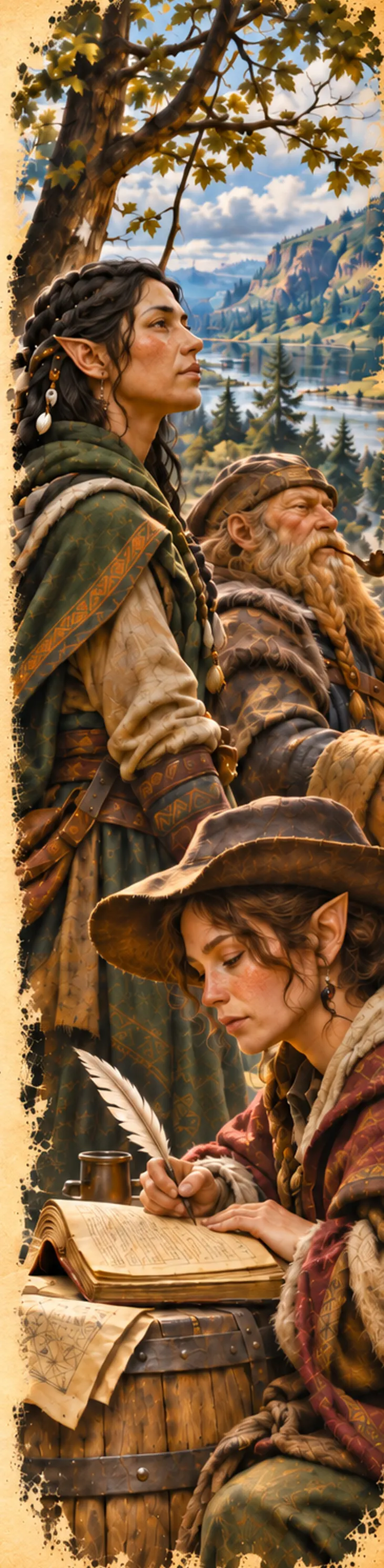
An elf woman and a pipe-smoking dwarf look over a river valley while a young elf writes in a book on a barrel.

The languages of the newcomers

Language Spoken by Notes
Charter The charter colonies and the halfling homesteads The common tongue of the eastern shore, its towns and its law. Every deed, warrant and newspaper on the coast is written in it.
Southron The southern crown The tongue of the crown, its missions and its coin. Spoken across the south and the canyon country, and by anyone who trades with them.
Courant The river traders Their own word for it means "the current", because it goes wherever the river does. The tongue of the forts and the fur trade in the north and down the great river.
Ledger The merchant company The colonists' name for it, after the book every company clerk lives by, and the company has stopped minding. The tongue of the counting houses. Few speak it outside the company, and every company man speaks at least one other tongue as well.

Old-world tongues. The seekers come from every nation of the old world. Most speak one of the four newcomer tongues already, and some speak an old-world tongue nobody on the continent knows.

Reading and writing

The newcomer tongues are written, and most newcomers can read and write their own. Most colonists can read Charter, and a printed notice is meant for everyone.

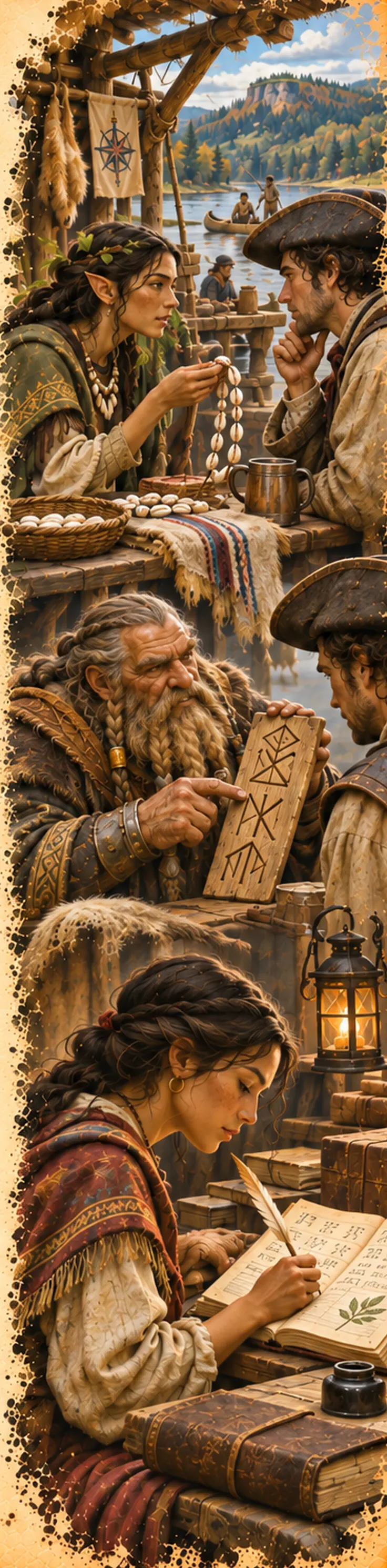
The dwarves write Deep-speech in runes. Anyone who speaks Deep-speech can read the everyday runes; only a runewright can read the runes of a working.

The elves do not write their tongues. The League keeps its agreements in strings of shell beads, whose patterns record what was promised, and only those taught to read them can. The boat-clans keep nothing in writing, on purpose.

A character can read and write every written language they speak, unless the player decides otherwise.

Speaking without a shared tongue

No shared language at all, not even Portage, means pointing and gestures. Persuasion, Deception, Insight and Performance take −2, and anything more than the simplest exchange is impossible.

The Tongues spell lets its target speak and understand every language spoken to them for an hour.

An elf trades shell beads with a frontiersman, a dwarf points to runes on a tablet, and a young woman writes in a book by lantern light.

Starting languages

A new character knows:

  • Portage.
  • The tongue of their people, from the table below.
  • One more language from the table's last column, or any other language their story gives them a reason to know.
People Native tongue One more, usually
Southern crown Southron Charter, Deep-speech or Plainsong
Charter colonies Charter League, Southron or Courant
River traders Courant League, Riverspeech or Charter
Merchant company Ledger Charter, Southron or Courant
Seekers Charter, Southron, Courant or Ledger Any newcomer tongue, or an old-world tongue nobody here speaks
Forest elves League Courant, Charter or Riverspeech
River elves Riverspeech League, Courant or Southron
Plains elves Plainsong Southron, Charter or League
Canyon dwarves Deep-speech (Canyon) Southron
Shore dwarves Deep-speech (Shore) Courant, League or Charter
Halfling homesteads Charter League

Envoys, Minstrels and Woods Runners start with one more language again: their trades are made of talking to strangers.

Learning a language

By living with it. A character who spends a season among speakers of a language, in downtime, can learn it for 2 experience.

By being taught. A character with a teacher can learn a language in a season of downtime for 2 experience, as above, wherever they are.

Formal League speech, the register used in council and in proper form, needs a season more, and a teacher who will take an outsider on. Without it, a League speaker who is not an elf addresses a council in proper form at −1.

Languages are not skills. A character speaks a language or does not. Knowledge (Cultures) covers knowing which peoples speak what, recognising a language, and knowing what is polite to say in it.